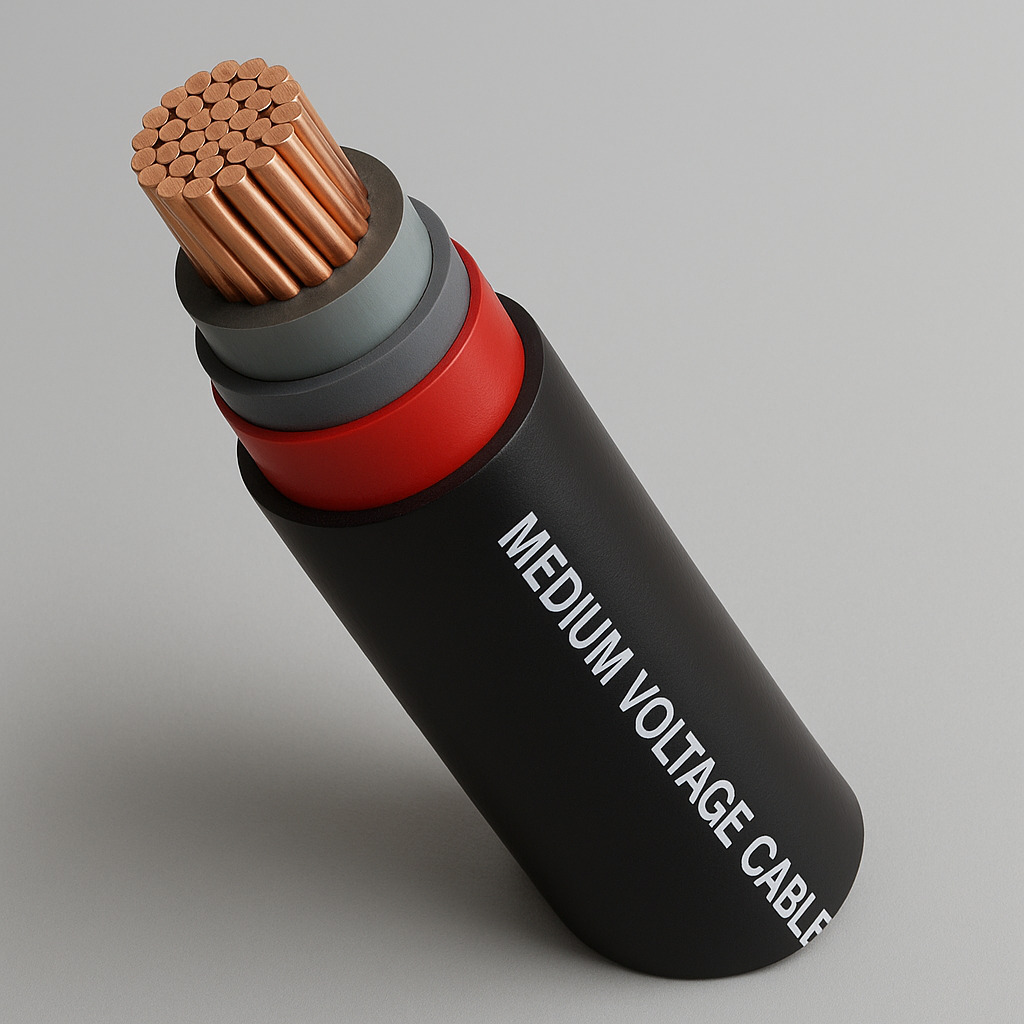
Medium voltage (MV) cables play the vital role of providing steady, effective, and dependable transmission of electric power in modern applications of power distribution. MV cables are in the power domain between 1 kV and 33 kV and form the backbone network between the substations, the transformers, and the industrial plants. Choosing the appropriate medium-voltage cable is more than purely a technical task; it also involves the aspects of safety, performance, and endurance.
It includes information regarding the key factors, standards, and technical specifications you must be aware of prior to choosing the right cable with the help of MV Cable Manufacturers for your electric network.
1. Learning Medium Voltage Cables
Medium-volt cable serves to transport power within the medium between the low-volt systems (less than 1 kV) and the high-volt transmission cable systems. They find widespread applications in industrial centres, buildings, renewable power centres, and power utility centres.
Every MV cable also contains three basic layers:
- Conductor: Typically copper or aluminium.
- Insulation: This is of material such as XLPE (cross-linked polyethylene) or EPR (ethylene propylene rubber).
- Sheath and Armour: Protection from mechanical injury, immersion and chemical action.
It all depends on how it is to be installed: underground, under the sea, or overhead.
2. Establishing the Voltage Class and Application
The simplest and most fundamental activity in cable selection is the determination of the voltage rating of the system. MV cables are often divided in the following order:
- 1–3.3 kV: Limited applications in industry or in local distribution.
- 6.6–11 kV: Common in small industrial or commercial circuits.
- 22–33 kV: Installed in large power utility centres, substations, or solar farms.
The cable’s rating for voltage must be identical to or higher than the system’s. The choice of cable with a lower rating of voltage than the system’s voltage would permit dielectric failure, and overrating could involve excessive cost.
Example:
Assuming your system is 11 kV, your system would require an 11 kV-rated XLPE insulated cable in order to provide it with performance and security.
3. Conductor Material: Copper or Aluminium
The material used for the conductor contributes to the cable’s efficacy, costliness, and handleability.
Copper Conductors
Pros:
- Good conductivity with low resistance.
- More flexibility and mechanical strength.
- Improved performance under heat stress.
Uses: For critical industrial applications, substations, or space-restricted areas.
Aluminum Conductors
Advantages
- Lightweight and less expensive.
- Reduced installation and handling specifications.
Uses: Long-distance transmission lines, renewable power plants, or economy-of-scale applications.
Brief: Copper offers better electric characteristics but aluminium offers an inexpensive choice for big installations once the weight and cost become larger factors.
4. Type of Insulation: Cable Performance Centres
The insulation is what indicates the cable’s capacity to resist electric stress and the environment. The most frequent type of insulation is:
XLPE (Cross-Linked Polyethylene)
Benefits:
- Improved heat and chemical resistance.
- More current-carrying capacity.
- Lowest dielectric loss.
Uses: Power transmission in underground power systems, renewable power networks, and utility uses.
EPR (Ethylene Propylene Rubber)
Pros:
- Better flexibility and heat resistance.
- Most adaptable for dynamic installations.
- General Applications: Coastal, mine power, or transport power service.
As an exception to uncertainty, XLPE-insulated cables are standard in the industry for most medium-voltage applications due to their efficient low maintenance and stable durability.
Medium-voltage cables must be properly shielded and physically protected in order to be safe and to reduce interference.
a) Lens Battery Trays
Metallic screen provides:
- Equal sharing of voltage because of the insulation.
- Hazard-free return routes for fault current.
- Reducing the interference of electromagnetic interference (EMI).
- Shielding material is copper tape or copper or aluminium wire screens, according to the specification of fault current.
b) Armour Protection
- Armoring shields the cables against climatic stresses and mechanical abuse.
- Steel Wire Armouring (SWA): Generally used in underground applications.
- Aluminium Wire Armour (AWA): Installed on single-core cables in order to deter eddy currents.
- Lead Sheath: Offers maximum level of resistance to chemicals and moisture, which is optimum for industrial applications.
- Installation position, risk of mechanical activity, and exposure status define which armoring type to use.
6. Installation and Environmental Conditions
Environmental factors expose the cable system to various stresses. The following conditions must be carefully considered:
a) Tunnel-Type Excavation
- Requires cables with moisture-resistant sheathing.
- SWA or AWA armoring is suggested for armoring against mechanical damage.
- Provide sufficient burial depth (usually 0.75–1.2).
b) Aerial or Duct Installation
- Cables must resist UV light and temperature changes.
- Use lightweight aluminium wires to relieve tension on support systems.
c) Industrial or Hazardous Sites
- Use flame-retardant, oil-resistant cabling that is also halogen-free.
- Double-armoured or lead-sheathed types provide maximum protection in chemical plants.
d) Exterior and Renewable Installations
- It needs to withstand sunlight, ozone, and temperature fluctuation.
- Use water-blocked construction details to avoid moisture intrusion.
- Grasp the environmental stresses in order to ensure long-term stability and lowered maintenance costs.
7. Cable Sizing and Current Carrying Capacity
- Sizing correctly will allow the cable to carry the anticipated current safely without excessive heat. Keep the following in mind:
- Load current and voltage drop: Excessive heat is produced by small cable; large cable is costly.
- Short-circuit withstand capacity: The cable should be able to withstand short circuits without getting destroyed.
- The soil’s resistivity and the surrounding temperature: Influence heat dissipation in buried underground cables.
Employing industry rules or software such as IEC 60287 or IEEE 835 facilitates the accurate determination of the current-carrying capacity with respect to real-time parameters in the field.
8. Certifications and Compliances with Standards
Make sure that your medium-voltage cables are acceptable internationally or regionally to guarantee performance, quality, and safety.
Typical standards are:
- IEC 60502-2 – Extruded insulation power cables (1–30 k
- BS 6622 – XLPE or EPR insulated armoured cable
- IS 7098 (Part 2) – Indian Standard MV power cables
- IEEE and ICEA standards – Used in the North American markets
These tests confirm that the cable has undergone rigorous tests for the electrical, thermal, and mechanical characteristics in harsh conditions.
Conclusion
Selecting the right medium voltage cable for your network is an educated decision with a straightforward effect on the network’s performance, safety, and lifespan. The material used in the conductor, the type of insulation used, the condition in which it’s installed and the standards compliance all matter.
- Calculate your needs for current and voltage.
- Choose suitable materials for conductors and insulation.
- Consider the installation environment and the standards for safety. Always buy cables from certified, quality manufacturers.
The correct MV cable provides smooth power delivery, minimizes operational hazards, and future-proofs your power systems. You invest in the best and the right one to begin with a power system that’s safe, effective, and reliable.
Also Read: Why Reeling and Trailing Cables Are Crucial for Mining & Industrial Use